
In my previous articles, I embarked on a journey of demystifying anxiety - exploring what it is, where it comes from, and what it may be trying to communicate to us.
One thing many women have in common when experiencing anxiety is a racing mind, overthinking, and an endless stream of overwhelming thoughts. Which brings me to one of the questions I often ask clients during our first therapy sessions:
"Are you your thoughts?"
Some people pause before answering. Others respond immediately, often looking slightly confused: “yes, absolutely”.
And truthfully, I did too.
When we live with anxiety, overthinking, or self-doubt, our thoughts can feel incredibly convincing. They often sound like facts rather than opinions.
"I should have done better."
"What if something goes wrong"
Over time, we can begin to identify so strongly with these thoughts that we forget they are simply mental events passing through our mind.
But what if you are not your thoughts?
The Glass and Water Analogy
I often use a simple analogy with clients.
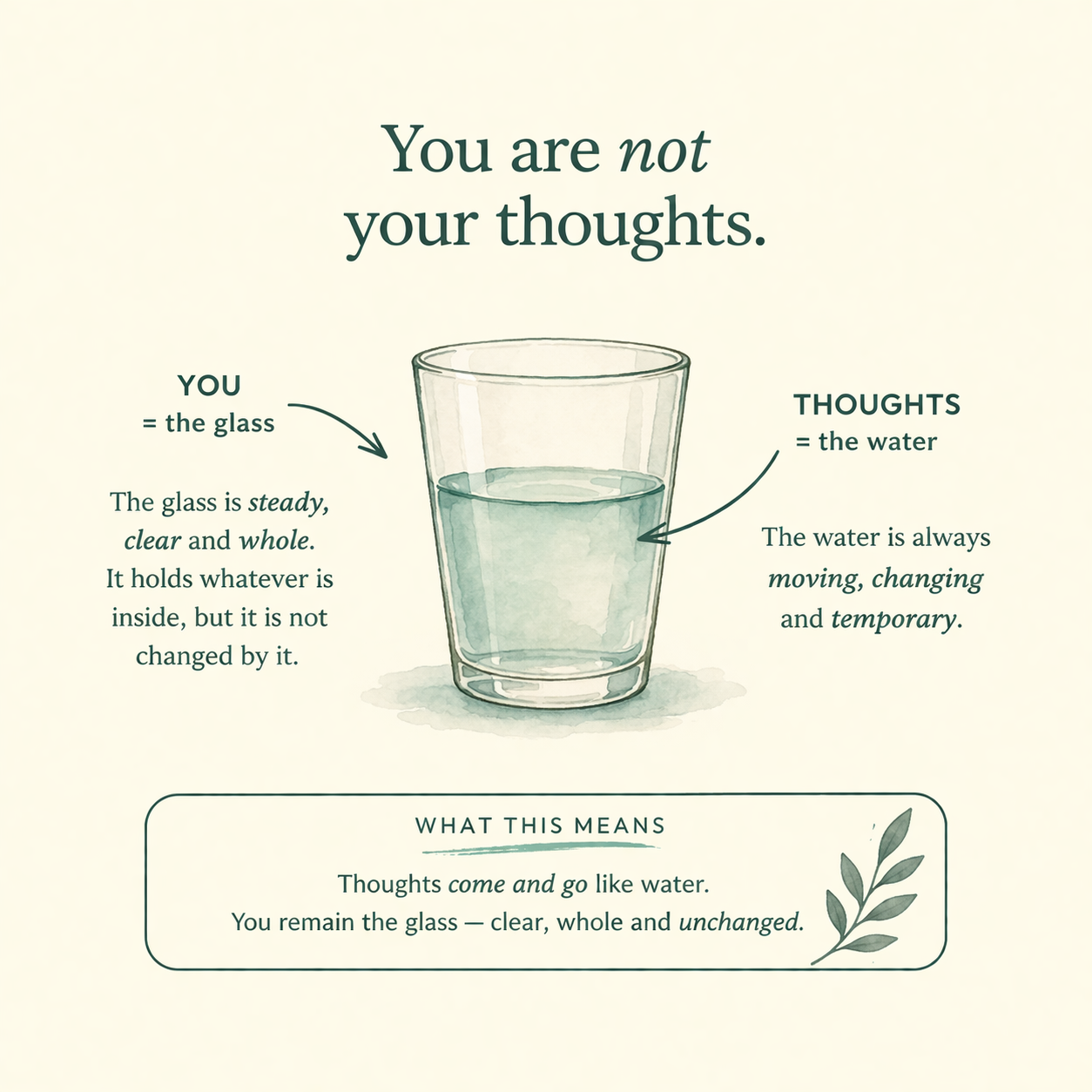
Imagine a glass filled with water.
The glass is you.
The water is your thoughts.
The water is constantly moving, changing, rising and falling. Some days it is calm. Other days it is cloudy, stormy, or overflowing with worries and predictions.
The glass, however, remains the same. It holds the water, but it is not the water.
In the same way, you can experience anxious thoughts, fearful thoughts, self-critical thoughts, and overthinking without those thoughts defining who you are. You are the awareness that notices them.
Why This Matters for Anxiety and Overthinking
Many people who struggle with anxiety become fused with their thoughts.
A thought appears: "Something bad is going to happen."And immediately it feels true. The body responds with tension, a racing heart, and a sense of danger. Yet a thought is not necessarily a fact.
One of the most important skills we learn in therapy is creating space between ourselves and our thoughts.
Instead of saying: "I am anxious." We might notice: "I am having anxious thoughts."
Instead of: "I am a failure." We might notice: "I am having the thought that I am a failure."
It seems like a small shift, but it changes everything.
A Different Relationship With Your Mind
The goal is not to stop thinking.
The goal is not to get rid of anxiety.
The goal is to develop a healthier relationship with your thoughts.
In therapy, we often learn to:
Notice our thoughts
Question whether they are facts or stories
Understand where they come from
Accept their presence without automatically believing them
Choose how we want to respond
When we stop identifying with every thought that enters our mind, we create room for greater clarity, calm, and self-compassion.
Remember This
Thoughts come and go.
Some are helpful. Some are painful. Some are simply passing through.
You do not need to believe every thought you think.
Perhaps you are not the water.
Perhaps you are the glass.
Steady. Whole. Unchanged.
Holding your thoughts without becoming them 🌿
If anxiety, overthinking, or self-criticism are something you struggle with, therapy can help you develop a different relationship with your thoughts, emotions, and body. Book a complimentary discovery call here.
Wherever you find yourself today, may this be a gentle reminder that you are more than your thoughts, more than your worries, and more than the stories your mind sometimes tells you.
