
Many of us describe ourselves as "overthinkers."
We replay conversations, analyse decisions, imagine different outcomes, and spend hours trying to find the perfect answer. The more uncertain we feel, the more our mind seems to work overtime.
But what if overthinking isn't the problem?
What if it is actually a protective mechanism?
Thinking vs Overthinking
Thinking helps us solve problems.
Overthinking happens when the mind keeps circling the same issue without reaching a resolution. We analyse, predict, replay and prepare, yet somehow end up feeling more stuck than before.
Often, overthinking creates the illusion of control while keeping us disconnected from action, emotion, and the present moment.
What Is Your Mind Trying to Do?
Overthinking usually comes from a good place.
Your mind may believe:
If I think about it enough, I'll find certainty.
If I prepare for every possibility, I won't get hurt.
If I analyse it enough, I won't make a mistake.
If I understand it perfectly, I can control the outcome.
The intention is protection.
The result is often anxiety, exhaustion, indecision, and feeling trapped inside our own head.
What is Underneath the Thinking?
In therapy, I often find that overthinking is not really about the thoughts themselves.
Beneath the thinking there is often:
Anxiety about the future
Fear of making the wrong decision
Perfectionism
A need for control
Grief, sadness, shame, or loneliness that has not yet been fully felt
Sometimes we are thinking instead of feeling.
A client may spend twenty minutes analysing an argument in great detail. Then when asked, "What did you feel?" the answer is often, "I don't know."
The mind can become a way of avoiding vulnerable emotions.
The Mind, Emotions and Body
I often explain overthinking through the lens of the three areas we work with in therapy:
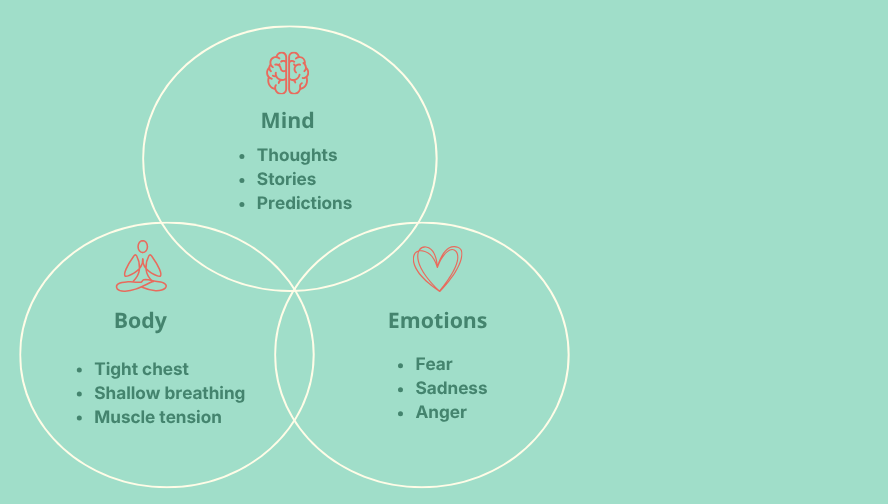
Many overthinkers spend most of their time in the Mind circle.
Healing often begins when we gently reconnect with the Emotions and Body circles as well.
A Different Question
Instead of asking:
"How do I stop overthinking?"
Try asking:
"If all the thinking stopped for a moment, what feeling would remain?"
These questions often reveal something deeper that needs our attention.
Moving Beyond Overthinking
When you notice yourself caught in a thinking loop, pause and ask:
Am I trying to solve a problem, or am I trying to solve uncertainty?
What action can I take right now?
What am I feeling in my body?
What emotion might be underneath all these thoughts?
Sometimes the answer is not another thought.
Sometimes the answer is allowing yourself to feel.
As I often tell clients:
Overthinking is often the mind trying to do the job of the heart.
The goal is not to stop thinking.
The goal is to stop using thinking as a substitute for feeling.
